Slay The Spire 2: All Characters And How To Play Them
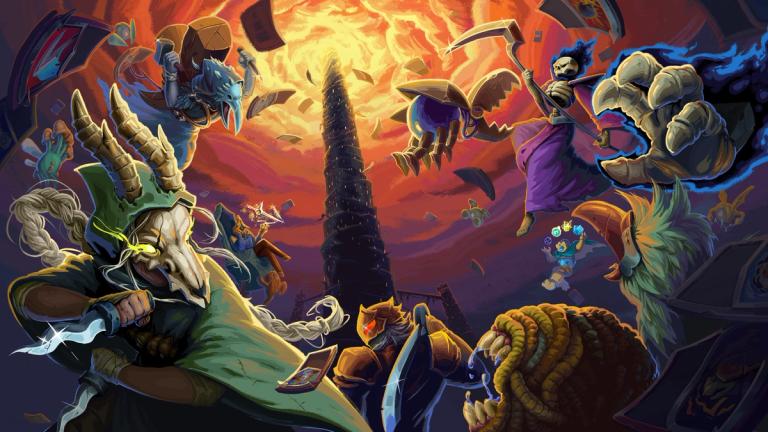
Featuring three returning faces and two new ones, Slay The Spire 2 kick off its Early Access phase already boasting more characters than the original.

How many acts are there in Slay The Spire 2?
Here are all characters in the game and how to play them. There are new ways to play the old classics, and the new additions have some unique playstyles that you might not expect!
The Defect Character Guide
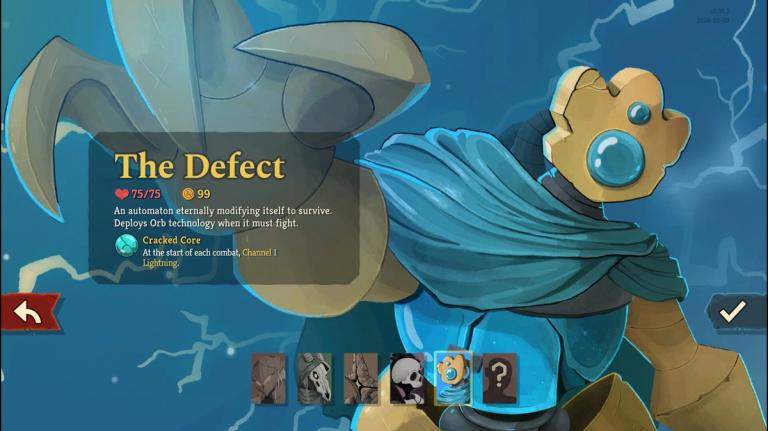
Players who come from the original Slay The Spire will be very familiar with Defect. He is the last character you unlock in Slay The Spire 2, but he hasn’t changed too much, although he looks much buffer this time around.
Their entire playstyle still revolves around the orbs. This makes it much heavier on preparation and systems-based gameplay than rushing down enemies. Defect uses a variety of orbs for different effects:
- Dark- Start at 6 damage and increases it by 6 passively at the end of each turn. Deals damage to the lowest HP enemy when Evoked.
- Frost- Passively generates 2 Block at the end of each turn. Generates 5 Block instead when Evoked.
- Lightning- Deals 3 damage to a random enemy passively at the end of the turn. Deals 8 damage instead when Evoked.
- Plasma- Passively Generates 1 Energy at the start of the turn, increased to 2 if Evoked.
Evoking is done via specific cards and consumes the Orb. Orb effects are increased by Focus, with the exception of Plasma Orbs, which are unaffected. You’ll have to invest into typically one of two Orb builds, so expect slow early games in all your runs.
Dark Orbs are tough to bump into, especially in your first runs with Defect, so we recommend starting off with a build focused on defense, with most of your damage coming from Lightning Orbs.
Once you’ve unlocked access to Dark Orbs more reliably (via the Epoch system), you can invest into more aggressive builds focused on Dark Orbs executing enemies quickly.
Starter Relic
Cracked Core- At the start of each combat, Channel 1 Lightning.
The Ironclad Character Guide
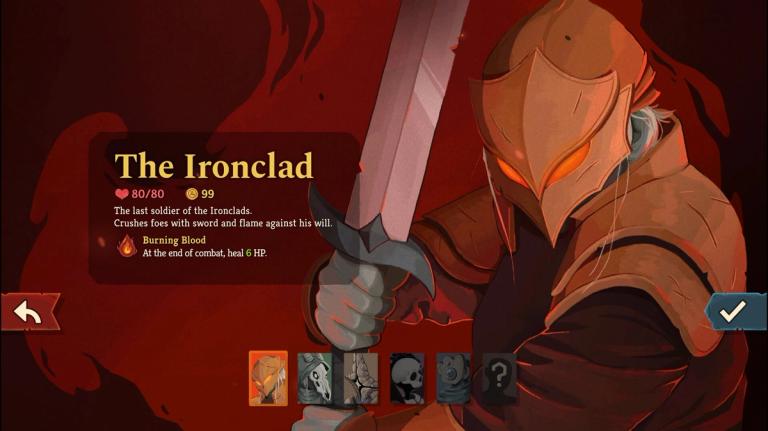
The face of the Slay The Spire franchise is back in the sequel and remains the starting character in the game. Ironclad is the best character to learn the game with, and also the one with which you can speedrun your earlier adventures.
This character doesn’t feature the specific systems that seem to be a focus of the rest of the roster, especially in Slay The Spire 2, it instead excels in maximizing the basics.
You can either focus on risky, damage-heavy rush-down decks, or a safer (but much slower) block-focused approach. The Ironclad allows you to be more aggressive than other characters because his innate Relic is a heal, but he can also shine with a deck focused on blocks.
Like most things in Slay The Spire 2, each playstyle excels against different opponents, but one is definitely easier to execute than the other. The block-heavy approach allows you to stay healthy throughout a run, letting you Upgrade a bunch of your cards on Rest Sites.
But if you manage to craft an effective aggressive deck around Strikes and Strength, you can absolutely smash an entire run from beginning to end.
Starter Relic
Burning Blood- At the end of combat, heal 6 HP.
The Necrobinder Character Guide
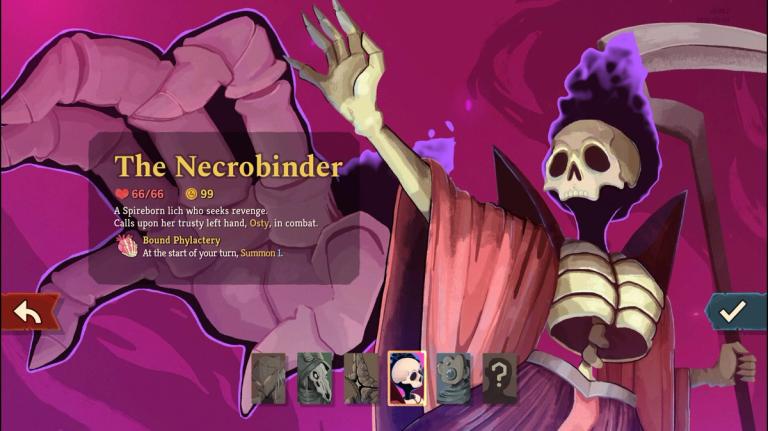
The Necrobinder is the second new face— well, skull— you’ll meet in Slay The Spire 2. While systems-heavy like The Defect, it plays in a quite unique manner. The Necrobinder is the only character who doesn’t fight alone, as it brings with it an animated skeletal hand called Osty.
This character has a unique effect, Summon, which brings Osty back if it died, or raises its HP for a specific value while it is alive. The value of this is two-fold: Osty tanks your unblocked damage before it hits you, essentially serving as an extra life bar, and there are specific cards which deal more damage the more HP Osty has.
The most intuitive and easiest build to pull of with the Necrobinder is a Summon-focused one. You stack up on Summon cards and use Osty as both your shield and your main weapon. Simple, but effective.
Alternatively, you can focus on the other Necrobinder-specific effect: Doom. Doom is Slay The Spire 2’s alternative to Poison. It doesn’t deal damage directly, but it marks the enemy’s HP with a specific value. If an enemy ends its turn at or below that value, it immediately dies, regardless of Block.
Doom-focused decks are typically harder to implement and depend a lot on Powers, but they are extremely effective when built correctly. You’ll need a ton of defensive cards and patience, but you’ll at times feel like you’re breaking the game.
Starter Relic
Bound Phylactery- At the start of your turn, Summon 1.
The Regent Character Guide
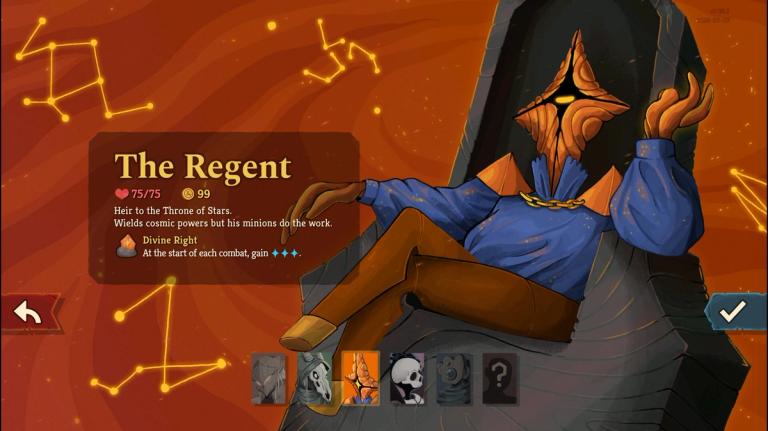
The first new face you’ll encounter in Slay The Spire 2 is The Regent— assuming it’s a face, that is. Like The Necrobinder, the heir to the Throne of Stars brings with it their own unique systems, but it plays out in a much simpler fashion.
The Regent features a relatively simple deck that can be divided into two distinct playstyles, but comes with an asterisk: Blue Stars. This characters has a unique, extra mana cost beyond Energy. Some (or a lot, if you opt for this playstyle) of his cards will cost 0 Energy, but a specific number of Blue Stars.
You can opt for a star-focused deck and, inside that option, choose a more defensive or aggressive approach, similar to what you find with The Ironclad. Alternatively, you can avoid cards with star cost as much as possible, opting instead for a Forge-focused deck. Yes, The Regent has another unique system: Forging.
Forge works in a similar way to Summon. The first time you use it, you create a Sovereign Blade, a simple Attack card that has Retain. Every time you Forge again in that combat you’ll instead raise Sovereign Blade’s damage. If your card has Forge 6, it raises the Blade’s damage by 6.
A Forge-focused deck revolves entirely around buffing the Sovereign Blade and hitting enemies with insanely powerful attacks. It sounds quite simple, but it requires you to pay close attention to the number of cards you have on your deck, because if you spent too long without a Sovereign Blade in your hand, you’ll most likely die.
Starter Relic
Divine Right- At the start of each combat, gain 3 Blue Stars.
The Silent Character Guide
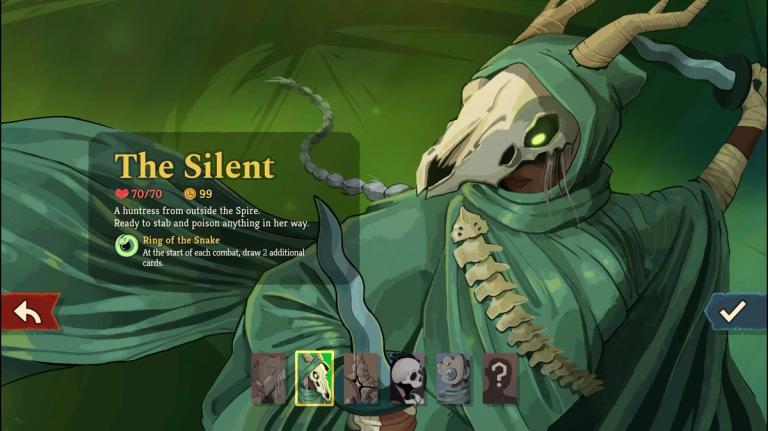
Lastly, we get another familiar face, The Silent. The original game’s rogue-archetype is back and in a similar fashion. Their Poison builds are back, much like the spammy, Shiv-focused ones.
While it is the second character you unlock, it isn’t as easy to pick-up as The Ironclad. Both Poison and Shiv builds seem simple, but the Silent can easily fall flat if you build them wrong.
With that being said, good builds will make them look absolutely broken. They can cheese a lot of Elites with the amount of damage and sheer amount of individual hits they can dish out in a single turn (The Silent absolutely trivializes The Statue, one of the toughest Elites in the game).
And despite a relative complexity to their playstyles, The Silent is the character which better deals with bloated decks, so they can make your early runs easier if you have trouble keeping a slimmer deck.
Poison-focused builds excel at slowly whittling down enemies, but require investment into defensive tools. Stack poison and protect yourself, be patient, and let the venom do its thing.
If you’re in a rush and just want to spam cards, Shiv builds will be for you. These are 0 cost cards that deal respectable damage, and which excel in decks that snowball out of having as many Shivs and Shiv-creating cards as possible. Just keep drawing and spamming 0-cost cards, and enjoy.
Starter Relic
Ring of the Snake- At the start of each combat, draw 2 additional cards.
Slay The Spire 2 Co-op, Explained