Introducing Rocket League Rating 1.0
Rating 1.0?
Rating 1.0 is a full refinement of the alpha model. The core structure is unchanged: players are rated per game on the same scale, with positive and negative actions throughout a game contributing to the final number.
What we have fundamentally changed with this version is the underlying philosophy. The alpha leaned heavily on a small number of high-impact events (primarily goals and the actions around them) and included some team-wide modifiers that moved every player's rating regardless of their individual contribution.
Rating 1.0 moves to a more granular, individualised model: more smaller non goal oriented events, each tied to a specific player's actions, with team-level context retained only where the moment itself is inherently a team event (kickoffs).
In addition to this we’ve added a lot more context around the actions - demos, 50/50’s, free plays, boost, positioning and a look at what happened after these events scale the impact they have on a players rating.
We've released our Rocket League Rating Alpha!
What goes into our new Rating 1.0?
The rating itself takes into account 10 core components and each aspect has different weightings based on impact as well as individual game and action based nuance. We also have an xG model that underlies many of these aspects to scale the rating impact of the components.
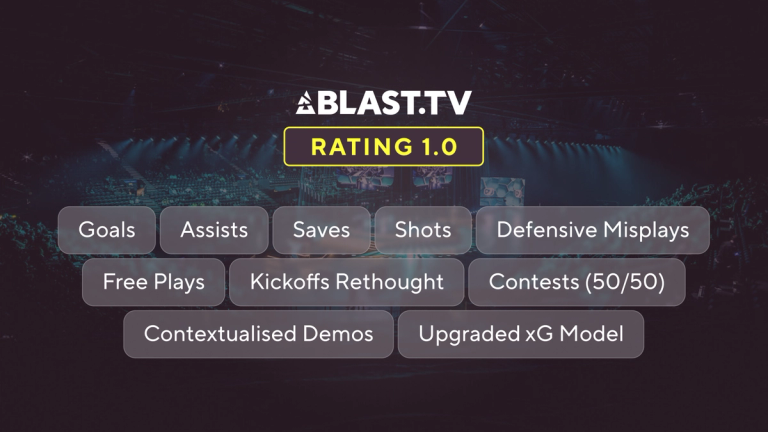
The components include:
- Goals
- Assists
- Saves
- Shots
- Defensive Misplays
- Free Plays
- 50/50s
- Kickoff Pressure and Outcomes
- Contextualised Demos
- Our underlying xG Model
These components were selected after analyzing player performance across more than 38,599 RLCS games, identifying how each datapoint correlates with winning, and weighing their influence on the rating accordingly.
We also made sure to include lower impact elements that consistently reflect strong individual pro play, even when they do not directly lead to a win.
Core Changes From the Alpha Rating
1. Upgraded xG (Expected Goals)
We’ve upgraded and extended the underlying models signals to more accurately reflect the likelihood of a player scoring from a shot as well as identified a bug in our shot angle feature meaning the model misread the ball's position relative to the goal.
As xG underpins a large share of the statistics feeding into the rating, this had large downstream effects across multiple datapoints. These changes recalibrates everything built on top of it.

What is xG (Expected Goals) in Rocket League?
2. Free Plays addition
A new datapoint identifying moments where a player has the time and space to make a play on the ball identified via ball proximity and opponent pressure. We classify the outcome of this event as positive, neutral, or negative and alter the rating with this in mind. This rewards players who consistently make good decisions in space and penalises those who waste good opportunities.
https://www.youtube.com/watch?v=5Y2beku0DD0&t=18238s
Example: in the clip above Atomic has a free play in his own half. He then proceeds to make an amazing play that ultimately leads to Beastmode scoring. With this new datapoint we know that Atomic made a great play leading into an assist which results in a larger boost to his rating. Previously we would have seen this as “just” a regular assist.
3. Defensive Misplays
In the alpha, most goals had no corresponding "blame" attribution, so the scoring team's ratings jumped while the conceding team saw no individual impact. Rating 1.0 introduces a system that evaluates a players positioning and impact in the moments before a goal or an opposition attacking action, and punishes specific players who have been deemed to have made a bad play.
The two core cases are scaled differently: goals carry a heavier negative weight than a general attacking action, since attacking actions are much more frequent and less definitive.
4. Kickoffs Rethought
Kickoffs in the alpha rating were attributed to a single player (whoever challenged for the ball), which fundamentally missed most of what actually happened in a kickoff. Rating 1.0 treats kickoffs as a tactical team event: the pressure a team exerts coming out of the kickoff is evaluated and the role each player played is attributed back to them. The outcome is classified as Positive, Neutral, or Negative.
Kickoffs are the one moment in RL where individual action is inseparable from team tactical execution, so this is a deliberate exception to the otherwise individualised model rather than a return to team-wide modifiers.
5. 50/50 positioning & context
The alpha treated all 50/50s as equal. 1.0 weights them by ball position relative to the pitch (a 50/50 in the defensive third matters more than one at midfield) and by the direct actions following the contest win/loss.
6. Demos with boost & context
Demos now factor in the boost level of the demoed player. A player demoed with high boost takes a larger negative rating impact, and the demoer receives a correspondingly larger positive impact. Low-boost demos still count but at reduced weight. We also take into account where the demo takes place and if it led to a significant action or opportunity for either team.
What we removed
Team pressure
This previously moved the rating of all players on a team based on game-wide pressure metrics. This conflicted with the individualised direction of 1.0 and has been removed.
Player activity
The alpha rewarded players for simply performing actions, regardless of quality or context. This added rating inflation without adding signal, so it's been removed in favour of the contextual events outlined above.
What does Rating 1.0’s distribution look like?
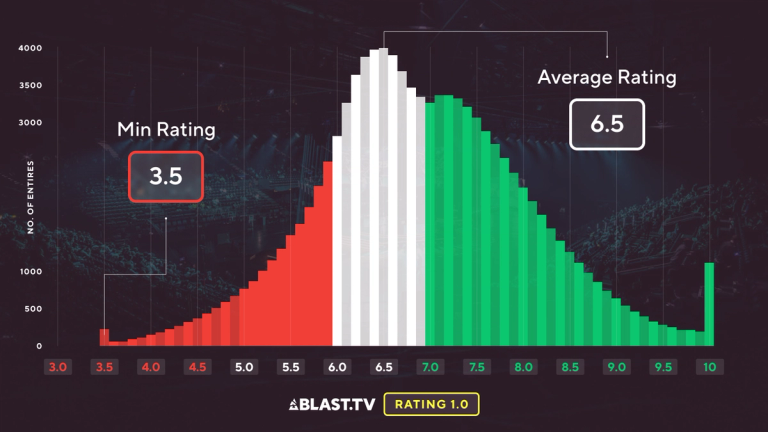
Across the full pro Rocket League dataset, Rating 1.0 produces a wider, more individualised spread of player performance than the alpha. The average sits at 6.5 with a long tail in both directions, which is what we'd expect from a model that aimed to separate individual contribution from team context. Under the alpha, team-wide modifiers pulled players toward their team's overall performance. A strong player on a struggling team was dragged down. A weaker player on a dominant team got carried up. Removing those modifiers means individual ratings now reflect individual play more directly, which was the whole point of the update.
How did it effect player ratings?
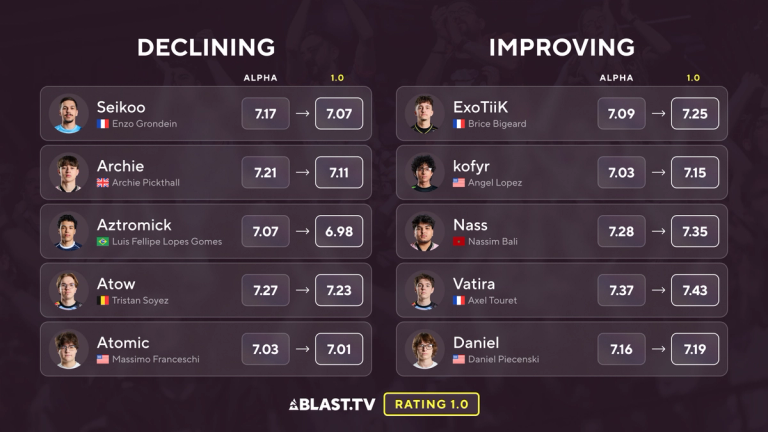
Most players moved less than 0.10 in either direction. Where larger shifts happened, they reflect how 1.0 weighs gameplay differently rather than any change in the player. Players whose ratings dropped tended to benefit from the alpha's team-pressure modifier or activity-based rewards, both of which 1.0 removes. Players whose ratings rose tend to do more of what 1.0 now measures: free plays in space, contextual demos, and defensive positioning the alpha couldn't see. It is important to note that every player listed here is still among the best in the world regardless of the change.
Our Final Word
Overall as before, our aim with Rating 1.0 is to explain what happens in the arena, but it’s just one way to look at performance. We’re still committed to iterating, evolving and improving it over time to fully reflect the incredibly complex game that is professional Rocket League as accurately as possible.
Even so, the clearest picture of a player’s performance always comes from watching the match yourself. So make sure to watch as many as you can!
We’d love your feedback and to hear what you think! So please let us know in our discord or on the RocketLeagueEsports subreddit.
The history of the Rating (So Far)
We've released our Rocket League Rating Alpha!

 Team Falcons
 Spacestation
 Team FalconsTeam FalconsSpacestationTeam Falcons